Announcement

Collapse
No announcement yet.

Story time: My first dry eye doc's malpractice

Collapse
X
 
  • Filter
  • Time
  • Show
Clear All
new posts

  • MGD1701
    replied
    Hi Patti
    first, you must take glands images as even the best doctors can not see glands atrophy from slit lamp, according to the opinion leader Dr/prof. Gupta. She has a patient, only 10% glands left but when she expressed glands, some oils come out. When she first saw the images, she was very surprised too.

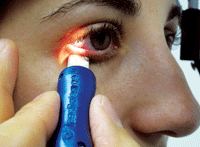
    2nd, dr must express glands see if any oil comes out, with finger or a tool invented by Dr Korb (see below picture). Gland images could look perfect but no/0 function = no oil comes out when dr express. Dr Korb mentioned this in his old videos 2012 or 2014.
    All these info plus other objective data can help decide HOW aggressively treamtments are required to stop progression

    MGD is progressive and is much easiler/economical to treat at the earlier stage but the problem is
    many doctors STILL do not examine/treat properly
    just send us away with (wrong) drops = no treatment = keep progression
    Examine glands function only takes 5 seconds with thumb or q-tip as picture show.
    so easy WHY doctor do not check????

    Last edited by MGD1701; 24-Aug-2018, 03:42.

    Leave a comment:


  • PattiS
    replied
    Thank you for all the helpful info edmunder.

    Leave a comment:


  • edmunder
    replied
    Originally posted by PattiS View Post
    How does one 'get evaluated' for gland dysfunction? what exactly is done to the patient. I have severe dry eye, I believe it comes from from RA, but no tests have been done on my eyes.
    Thanks in advance!

    Great question Patti.

    Find a dry eye doctor who will take pictures of your glands with a special camera. They can also press on your glands snd see which are expressing oil. They can put a dye in your rye, have you blink snd see the oil film on your eye snd see how fast it evaporates called TBUT tear break up time.

    Find a good doctor. You may have to drive to a larger city near you if you are ina small town. I would start calling today or tomorrow morning and get one.

    The camera is either a Lipiview or Oculus.

    Leave a comment:


  • PattiS
    replied
    How does one 'get evaluated' for gland dysfunction? what exactly is done to the patient. I have severe dry eye, I believe it comes from from RA, but no tests have been done on my eyes.
    Thanks in advance!

    Leave a comment:


  • MGD1701
    replied
    Originally posted by Claddagh View Post
    Hi Mgd 1u01 and Hokucat...you both are very knowledgeable and a great asset to this site. I am interested in the effectiveness of Natrasan ....diet and what is the best warm compress you have learnt to adapt after many years of research.
    NatraSan pure HOCL spray - please read my earlier post, #9

    http://forum.dryeyezone.com/forum/dr...eyelid-hygiene

    The best to learn more is from the videos - at least the one I posted above (from Aveonva). Just bear in mind, NatraSan is NOT Avenova. Please learn more first.

    compress - have replied to your another posting


    Leave a comment:


  • Hokucat
    replied
    Claddagh , MGD1701 is the expert at using Natrasan and warm compress, so she would be best to give advice on this. I’ve never used Natrasan and rarely use warm compress anymore. However the warm compress I found molded well to the eyes and holds its warmth well was Themalon:

    https://www.amazon.com/Thermalon-243.../dp/B004385RPS

    As far as probing, it is a quite invasive and uncomfortable procedure, and would try less invasive procedures first like LipiFlow and/or IPL. Assuming you have MGD, have you tried either of those yet? If at some point you look into probing, you’re right it’s virtually unheard of in the UK. However I did find this thread that lists a couple of UK probing doctors:

    http://forum.dryeyezone.com/forum/dr...iflow-uk/page3

    As far as diet, everyone has different underlying conditions, so the diet that works for one may not work for another. But here is what I typically follow each day ~80% of the time, in case something here helps you:

    I limit gluten, dairy, and sugars. These three things always made and still make my eyes feel worse.

    BREAKFAST - I've found I need to start off the day with my main meal:
    -Drink one cup water as soon as wake up.
    -Spinach or dark leafy greens salad. Extra virgin olive oil with fresh grinded peppercorns and a little salt for dressing.
    -One cup fresh berries (strawberries, blueberries, blackberries)
    -Small portion of protein (usually chicken or salmon, but find a good cut of steak or filet mignon for some reason always makes my eyes feel even better)
    -Green tea with juice from 1/6 of medium to large meyer lemon and slice of crushed ginger
    -Supplements related to eyes - Ocuvite-type eye vitamin, flaxseed oil, fish oil, vitamin A, bilberry

    DURING DAY:
    -One cup fresh vegetable juice (or thawed from frozen - I juice once a week and freeze it). A rainbow of colors: Kale, chard, parsley, bok choy, cucumbers, beets, carrots, butternut squash, apple.
    -Snack on nuts and fruit (bananas, melons).
    -Drink lots of water.
    -Green tea with lemon and ginger
    -If I’m going to eat something not so healthy like pasta or a sandwich, cookies, chips, etc. I’ll eat a small portion here in the middle of the day, as it seems to have the least negative effect on my eyes, as long as I had my good breakfast.

    DINNER:
    -Small portion of protein
    -Vegetables (usually broccoli, asparagus, etc., something dark green)

    EVENING:
    -Chamomile tea
    -Drink a cup of water right before bed

    Last edited by Hokucat; 21-Aug-2018, 13:02.

    Leave a comment:


  • MGD1701
    replied
    Just found this interesting article, dated August 13, 2018

    ''Caroline Blackie, O.D., medical director for dry eye at Johnson & Johnson Vision and longtime collaborator of Dr. Korb, has been on the front lines of MGD research. Drs. Korb and Blackie have long argued that doctors of optometry should look for MGD first and the management of most dry eye will follow. ....

    Based on her research, Dr. Blackie lists the must-knows for doctors of optometry:
    • MGD is highly prevalent. "It's everywhere-at least 50 percent or more of your patients are going to have this," she says. "That's based on clinical data."
    • MGD is best treated early. "Treating it earlier means you have to diagnose it earlier," she says. "Diagnose MGD at the first sign of compromise (inflammation and lid swelling) rather than wait for late-stage symptoms."
    • MGD is best attacked by addressing the obstruction of the glands' pores. "Obstruction is the core mechanism of the disease," Dr. Blackie says. "That means evacuating gland content. Squeeze the dickens out of those things."


    "We should be routinely evaluating gland dysfunction and structure on all patients to take control of ocular surface health," Dr. Blackie says.''

    More https://www.aoa.org/news/clinical-ey...erstanding-mgd
    Last edited by MGD1701; 21-Aug-2018, 00:54.

    Leave a comment:


  • Claddagh
    replied
    Hi Mgd 1u01 and Hokucat...you both are very knowledgeable and a great asset to this site. I am interested in the effectiveness of Natrasan ....diet and what is the best warm compress you have learnt to adapt after many years of research. I live I the UK and probing is unheard of so any advice will be greatly appreciated.

    Leave a comment:


  • MGD1701
    replied
    I think to examine glands during each visit is very basis and humble request.

    A few top leaders in USA mentioned many doctors do NOT even know
    visual flucuations (= unstable tear film) = a sign of dry eye/MGD.

    Leave a comment:


  • Hokucat
    replied
    Getting different perspectives from different doctors is valuable, including different types of doctors like nauturopaths, rheumatologists, etc. I learned something from almost every doctor I saw. If your condition is not getting resolved, definitely continue to seek other treatment options and/or specialists for your condition or what leads you have on what your underlying condition might be. If I didn’t do that, I would still today be suffering at the debilitating level I was at for many years.

    When I had tried just about everything, and all the doctors I saw said there was nothing else they could do for me, I asked my main doctor to refer/bless me for a probing consult. He had never heard of it, so I brought him info to educate him, as it is important at least my main eye doctor understand why I’m pursuing a certain treatment he may not provide, plus he might need to work with the different specialists I see. Probing was still a VERY new procedure back then, and few doctors did it, but based on everything I had tried and looking back at my condition getting worse and worse over the years, I suspected (or should say was hoping) my glands were blocked with scar tissue, or otherwise not producing oil any more. I did all the research myself on probing and found the probe doctor myself. Probing turned out to be the key first step to helping my condition, since it turned out I did indeed have deep scar tissue in many of my glands that no other treatment or procedure could unblock. And it did take several probe procedures before I found the diet changes that helped my oils flow better and not get blocked again. So sometimes the same procedure does need to be repeated, especially in conjunction with something else, in my case, the second key step of the right diet changes.

    Leave a comment:


  • Guest's Avatar
    Guest replied
    Originally posted by Hokucat View Post
    Dowork123 , I just wanted to know the status of my glands, if they were starting to get blocked up again, pure and simple. I have not had a probe for three years now, and it is indeed such an invasive and uncomfortable procedure, I would not have another one again unless I was really bad off. I have had other issues with her as well, so if I don’t feel I’m getting the attention I need anymore, of course I’m going to to look for another doctor. I know a lot more than I used to, so checking the status of my glands early is important to me.
    I agree, especially if you ask. I think that's a huge failure...I'm still working with different doctors because they all offer a different perspective. Looks like it's my thyroid..so I'm glad I kept pushing. There were a few times family members told me to stop. So I was just curious what your take was on pushing for better care.

    Leave a comment:


  • Hokucat
    replied
    Dowork123 , I just wanted to know the status of my glands, if they were starting to get blocked up again, pure and simple. I have not had a probe for three years now, and it is indeed such an invasive and uncomfortable procedure, I would not have another one again unless I was really bad off. I have had other issues with her as well, so if I don’t feel I’m getting the attention I need anymore, of course I’m going to to look for another doctor. I know a lot more than I used to, so checking the status of my glands early is important to me.

    Leave a comment:


  • Guest's Avatar
    Guest replied
    Originally posted by Hokucat View Post
    hopeful_hiker , that was certainly a frustrating experience. It likely will not be your last.

    Earlier this year I was using the computer more regularly for a few weeks, and my eyes got drier. When I went to see my dry eye specialist/probe doctor to check my glands, she instead said she would put me back on serum tears, without checking my glands. I asked again if she could check my glands, to determine whether I might need another probing at some point, and she said just try the serum tears again. She said she does not want to do probing too much because it is still relatively new and very invasive and the long term effects of the procedure are not known (which I can’t disagree), but still she should have checked my glands. I was quite disappointed with her, as she is very skilled at probing which helped me, and she knows I have a history of severe MGD, so why wouldn’t she always check my glands at my check ups, especially if I have more dryness than usual? So needless to say, even I am looking for another dry eye specialist now, when I thought I had a decent one!
    Im not defending your doc, I agree, she should have looked at your glands. That said, I'm assuming she didn't because no matter what she saw, she felt she shouldn't continue treating you, so why look. It's the only thing that makes sense based on her comments. She said she wouldn't probe again, so if she saw your glands were bad, it wouldn't change her treatment. So she said, go back on serum, safe, effective and will hold you over until you are in desperate need of probing again.

    Again, not defending her, just going through her thought process. I think she should have looked especially if you asked her to. But let me also ask, what would you have wanted her to do? Do you feel you needed a treatment?

    im asking only because I'm curious when do we stop doing procedures? When do we know we need one and should go to another doc? This is one of the hardest questions for me to answer. When is it too much, when is it not enough.

    Leave a comment:


  • MGD1701
    replied
    Hi Hokucat, good idea.
    I would find a dr with a confocal microscopy to examine gland density, fibrosis etc.
    Have you done such test? if so, lucky you. Good luck!
    Last edited by MGD1701; 20-Aug-2018, 07:17.

    Leave a comment:


  • Hokucat
    replied
    hopeful_hiker , that was certainly a frustrating experience. It likely will not be your last.

    Earlier this year I was using the computer more regularly for a few weeks, and my eyes got drier. When I went to see my dry eye specialist/probe doctor to check my glands, she instead said she would put me back on serum tears, without checking my glands. I asked again if she could check my glands, to determine whether I might need another probing at some point, and she said just try the serum tears again. She said she does not want to do probing too much because it is still relatively new and very invasive and the long term effects of the procedure are not known (which I can’t disagree), but still she should have checked my glands. I was quite disappointed with her, as she is very skilled at probing which helped me, and she knows I have a history of severe MGD, so why wouldn’t she always check my glands at my check ups, especially if I have more dryness than usual? So needless to say, even I am looking for another dry eye specialist now, when I thought I had a decent one!

    Leave a comment:

Working...
X